TL;DR:
- Digital dentistry uses computer-based tools like scanners and 3D printers to improve dental treatments and patient comfort. It enables faster, more accurate restorations with fewer appointments and better communication. Full digital workflows require skilled clinicians and on-site fabrication for maximum benefits.
Digital dentistry is defined as the use of computer-based technologies and devices to enhance dental diagnostics, treatment planning, and restoration, replacing conventional manual methods with digital workflows. The FDI World Dental Federation describes it as the integration of computer-aided technologies such as intraoral scanners and CAD/CAM systems into clinical practice to improve precision and patient safety. For patients in Fulham and London, this means fewer uncomfortable impressions, faster results, and treatments planned with far greater accuracy than traditional methods allow. Bespokedentalfulham uses these digital approaches to deliver cosmetic and restorative care that is both precise and personal.
What is digital dentistry and what tools does it use?
Digital dentistry covers a family of technologies that work together across the full treatment process, from the first scan of your teeth to the final fitting of a crown or veneer. Understanding each tool helps you know what to expect when you visit a digitally enabled practice.
Intraoral scanners
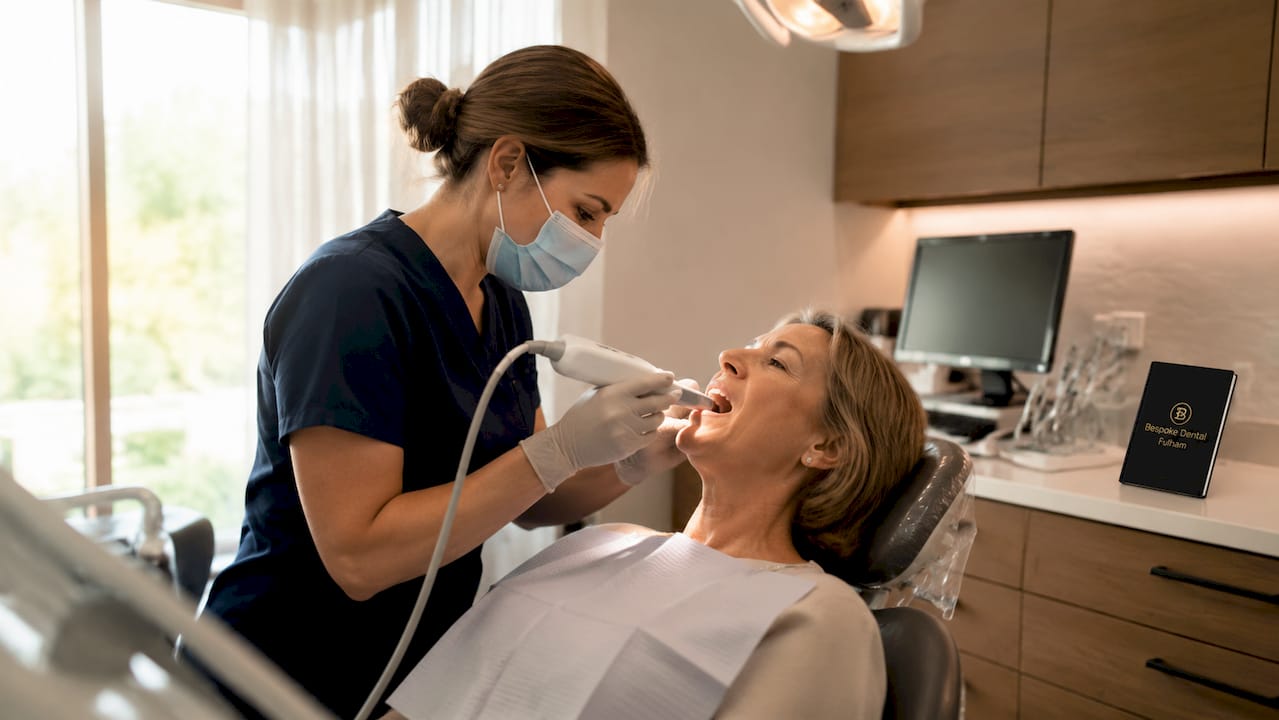
An intraoral scanner is a small wand that captures thousands of images per second inside your mouth, building a precise 3D model of your teeth in minutes. This replaces traditional impression materials, the gooey trays that many patients find uncomfortable or triggering of a gag reflex. The digital model is accurate, shareable, and stored instantly.
CAD/CAM design software
CAD/CAM stands for computer-aided design and computer-aided manufacture. Once your scan is complete, a dentist uses CAD software to design a restoration, such as a crown, inlay, or veneer, on screen. The design is then sent directly to a milling machine or 3D printer to produce the finished piece, often within the same appointment.
3D printing and in-house milling
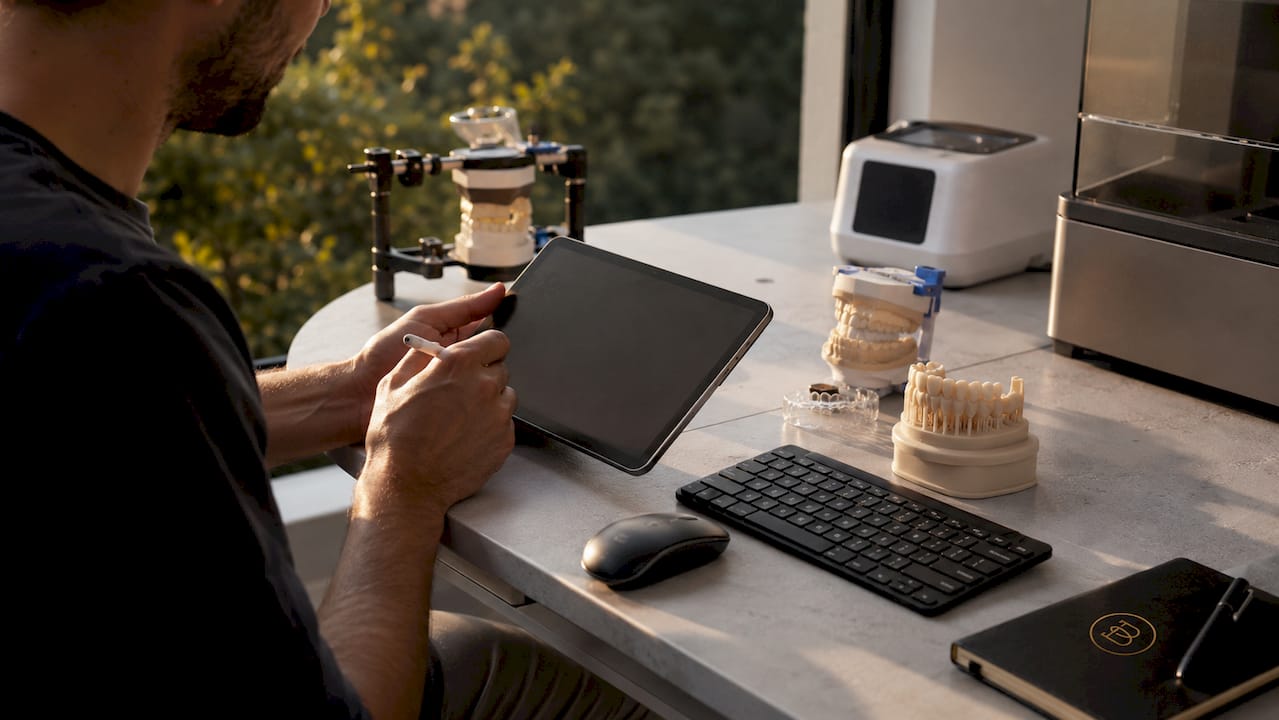
3D printing has transformed dentistry by enabling rapid in-house fabrication of provisional crowns, surgical guides, and dentures. That speed matters because it removes the need to send work to an external laboratory, which traditionally added days or weeks to treatment time. Milling machines carve restorations from solid blocks of ceramic or composite resin with high dimensional accuracy.
Digital imaging: CBCT and digital X-rays
Cone beam computed tomography (CBCT) produces a three-dimensional image of your jaw, teeth, and bone structure in a single low-dose scan. Digital X-rays use up to 90% less radiation than traditional film and display results on screen within seconds. Both technologies give your dentist a far richer picture of your oral health than a standard two-dimensional X-ray ever could.
Artificial intelligence in diagnostics
Artificial intelligence is now used to analyse digital scans and X-rays, flagging early signs of decay, bone loss, or misalignment that a human eye might miss at first glance. AI does not replace clinical judgement. It acts as a second layer of review, improving diagnostic consistency.
Pro Tip: Ask your practice whether they use a fully digital workflow, including intraoral scanning and in-house milling, or only digital X-rays. Some clinics label themselves digital but still take physical impressions, which limits the benefits you receive.
What are the benefits of digital dentistry for patients?
The advantages of digital dentistry are practical and immediate. Patients notice the difference from the very first appointment.
- No more gooey impressions. Intraoral scanners capture your teeth digitally, removing the discomfort of traditional impression trays entirely.
- Faster treatment. Same-day crowns are possible when a practice has in-house milling. What once required two appointments and a two-week laboratory wait can now be completed in a single visit.
- Better fit. Digital restorations are designed and milled to precise tolerances, reducing the need for adjustments at the fitting stage.
- Clearer communication. Chairside visualisation of 3D models allows you to see your planned treatment before it begins, which builds confidence and reduces anxiety.
- Long-term records. Digital dental data is stored securely using cloud-based systems, enabling long-term monitoring and eliminating the risk of losing physical plaster models.
- Environmental benefit. Digital workflows reduce the use of plaster, impression materials, and physical postage between clinics and laboratories.
A 2025 systematic review found that digital workflows provide superior accuracy and patient satisfaction compared with conventional methods, with less invasive impressions and reduced treatment time. Restoration survival rates between digital and traditional approaches are broadly comparable, meaning you gain comfort and speed without sacrificing durability.
For patients considering dental restoration options in Fulham, the combination of accuracy and speed makes digital dentistry a meaningful upgrade over older techniques.
How does digital dentistry compare with traditional methods?
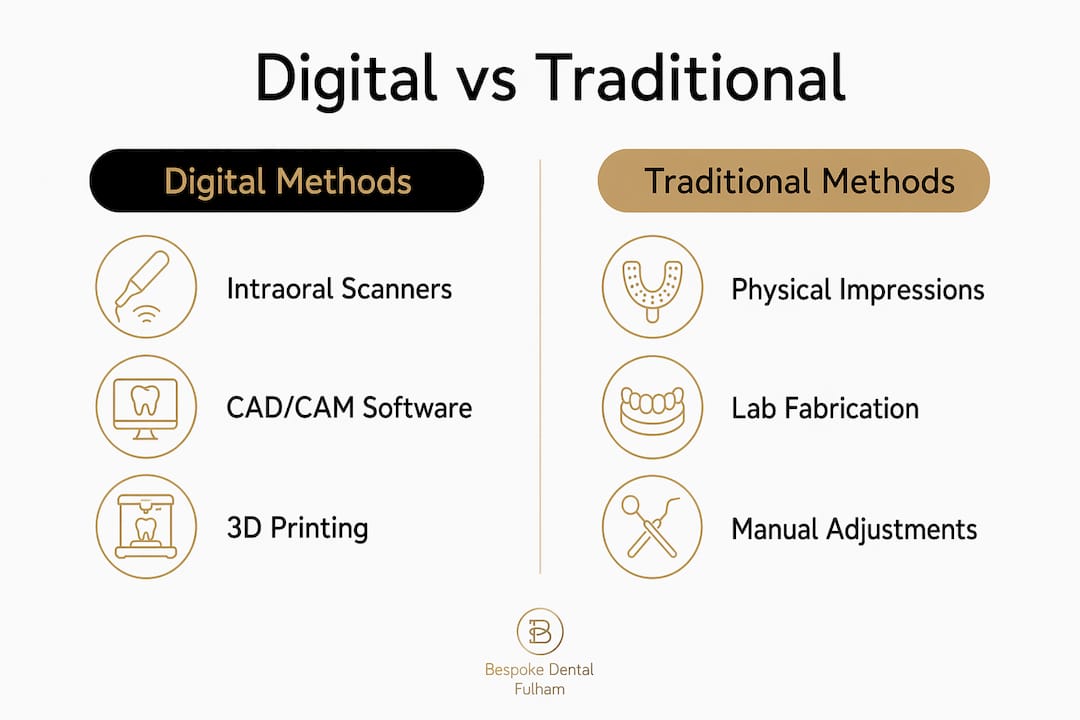
Digital dentistry does not make traditional dentistry obsolete. It improves specific parts of the workflow where technology adds measurable value.
| Aspect | Digital methods | Traditional methods |
|---|---|---|
| Impressions | Intraoral scanner, no material required | Physical trays with alginate or silicone |
| Turnaround time | Same-day restorations possible | Typically 1–2 weeks via laboratory |
| Accuracy | High dimensional precision from scan to mill | Dependent on impression quality and handling |
| Patient comfort | Minimal discomfort, no gag risk | Discomfort common, gag reflex a concern |
| Record keeping | Secure digital files, easily shared | Physical models, risk of damage or loss |
| Clinician skill required | High, for interpreting digital data | High, for manual impression technique |
One important limitation is that digital scanners can struggle to capture detailed margins when gum inflammation is present. Swollen or bleeding gum tissue obscures the edge of a tooth preparation, which can affect restoration fit. This is why gum health is assessed before digital impressions are taken, and why some patients are advised to complete a hygiene appointment first.
Clinician expertise remains critical despite technological advances. The technology requires significant investment in training, and a poorly interpreted scan produces a poorly fitting restoration regardless of the equipment used.
Pro Tip: Before booking a digital dentistry appointment, ask whether your gums are healthy enough for scanning. A quick hygiene visit beforehand can significantly improve scan quality and the final fit of your restoration.
How is digital dentistry practised in Fulham and London?
Patients in Fulham and across London now have access to practices that run fully digital workflows from scan to fit. The experience differs noticeably from a traditional dental visit.
- Your first appointment begins with a scan. Instead of biting into impression trays, you sit comfortably while a small scanner wand maps your teeth in three dimensions. The process takes around five minutes.
- Treatment is planned on screen. Your dentist designs your crown, veneer, or aligner using CAD software, and you can view the planned result before any work begins. This digital smile design process gives you a clear picture of the outcome.
- Restorations are made in-house. Practices with milling units or 3D printers produce your restoration on site, which means fewer visits and no waiting for laboratory returns.
- Fewer appointments overall. A crown that once required three visits, including a temporary fitting, can now be completed in one or two.
- Digital records follow you. Your scan data is stored securely and can be shared with other clinicians or used to monitor changes over time.
Not every practice in London offers the full package. Some use digital X-rays only, while others have invested in the complete workflow including intraoral scanning, CAD/CAM design, and in-house fabrication. When choosing a clinic in Fulham or the surrounding areas of Parsons Green, Hammersmith, or Chelsea, ask specifically whether they have an in-house milling unit or 3D printer. That distinction separates a partially digital practice from a fully digital one.
The future of digital dentistry points toward greater integration of AI-powered design and patient-specific fabrication, making treatments faster and more personalised with each passing year. Patients who choose digitally enabled practices in London today are already experiencing what will become the standard of care across the profession.
You can explore advanced dental technology in more detail to understand how these tools fit into a full treatment plan.
Key takeaways
Digital dentistry delivers measurable improvements in accuracy, patient comfort, and treatment speed, but its full benefits depend on a fully integrated workflow and a skilled clinician interpreting the data.
| Point | Details |
|---|---|
| Core definition | Digital dentistry uses intraoral scanners, CAD/CAM, and 3D printing to replace manual dental methods. |
| Patient comfort | Digital impressions remove the discomfort of traditional trays and reduce gag reflex risk entirely. |
| Speed advantage | In-house milling enables same-day crowns, cutting multi-week laboratory waits to a single visit. |
| Limitations exist | Gum inflammation can reduce scan accuracy, making prior hygiene treatment important for best results. |
| Clinician skill matters | Technology improves precision but does not replace the judgement of an experienced dentist. |
Why I think digital dentistry is the most significant shift in patient care I have seen
I have watched digital workflows move from a novelty to a genuine clinical standard over the past decade, and the change for patients has been profound. The most striking shift is not the speed or the accuracy, though both are real. It is the moment a patient sees their own teeth in three dimensions on a screen for the first time. That single visual changes the entire conversation. Treatment plans that once required lengthy verbal explanation become immediately clear.
What I find underappreciated is how much the technology exposes the limits of the clinician using it. A poorly taken scan, or a CAD design that ignores the patient’s bite, produces a result no better than a bad traditional impression. The equipment does not compensate for poor clinical thinking. The practices that get the best outcomes are those where the dentist has invested as much in training as in hardware.
The honest truth about digital dentistry in London is that access is uneven. Many practices have adopted digital X-rays and call themselves digital, while continuing to use physical impressions for restorations. Patients deserve to know the difference. A truly digital workflow, from scan through CAD design to in-house fabrication, is a different experience entirely, and it is worth seeking out.
The future I expect to see in Fulham and across London is one where AI-assisted design becomes routine, where virtual try-ins before any physical work begins are standard, and where the gap between diagnosis and finished restoration narrows to a single appointment for most treatments. That future is already here for patients who know where to look.
— Amit
Digital dentistry at Bespokedentalfulham
Bespokedentalfulham uses advanced digital workflows to deliver cosmetic and restorative treatments with the accuracy and comfort that patients in Fulham and London expect from a private practice. From intraoral scanning to CAD/CAM design, every stage of your care is planned with precision.
Whether you are considering veneers, crowns, or a complete smile refresh, the benefits of cosmetic dentistry are amplified when delivered through a fully digital workflow. Bespokedentalfulham also offers restorative dentistry options for patients in SW6, Parsons Green, and Chelsea who want durable, natural-looking results. Contact the practice to arrange a consultation and see your treatment planned on screen before any work begins.
FAQ
What is digital dentistry in simple terms?
Digital dentistry is the use of computer-based tools, including intraoral scanners, CAD/CAM software, and 3D printers, to plan and deliver dental treatments more accurately and comfortably than traditional methods.
Is digital dentistry safe?
Digital dentistry is safe and widely used in private practices across London. Digital X-rays use significantly less radiation than traditional film, and intraoral scanners involve no materials or chemicals.
Can I get a crown in one day with digital dentistry?
Same-day crowns are possible when a practice has in-house milling equipment. Intraoral scanning enables on-site fabrication of restorations within a single appointment, removing the need for a temporary crown and a second visit.
Does digital dentistry cost more than traditional dentistry?
Digital treatments can carry a higher upfront cost due to equipment investment, but the reduction in appointments and laboratory fees often offsets this. Practices in Fulham vary in pricing, so it is worth asking for a full treatment breakdown during your consultation.
How do I know if a practice is truly digital?
A fully digital practice uses intraoral scanning instead of physical impressions and has in-house milling or 3D printing for restorations. Practices that only use digital X-rays are partially digital and do not offer the full range of digital workflow benefits.